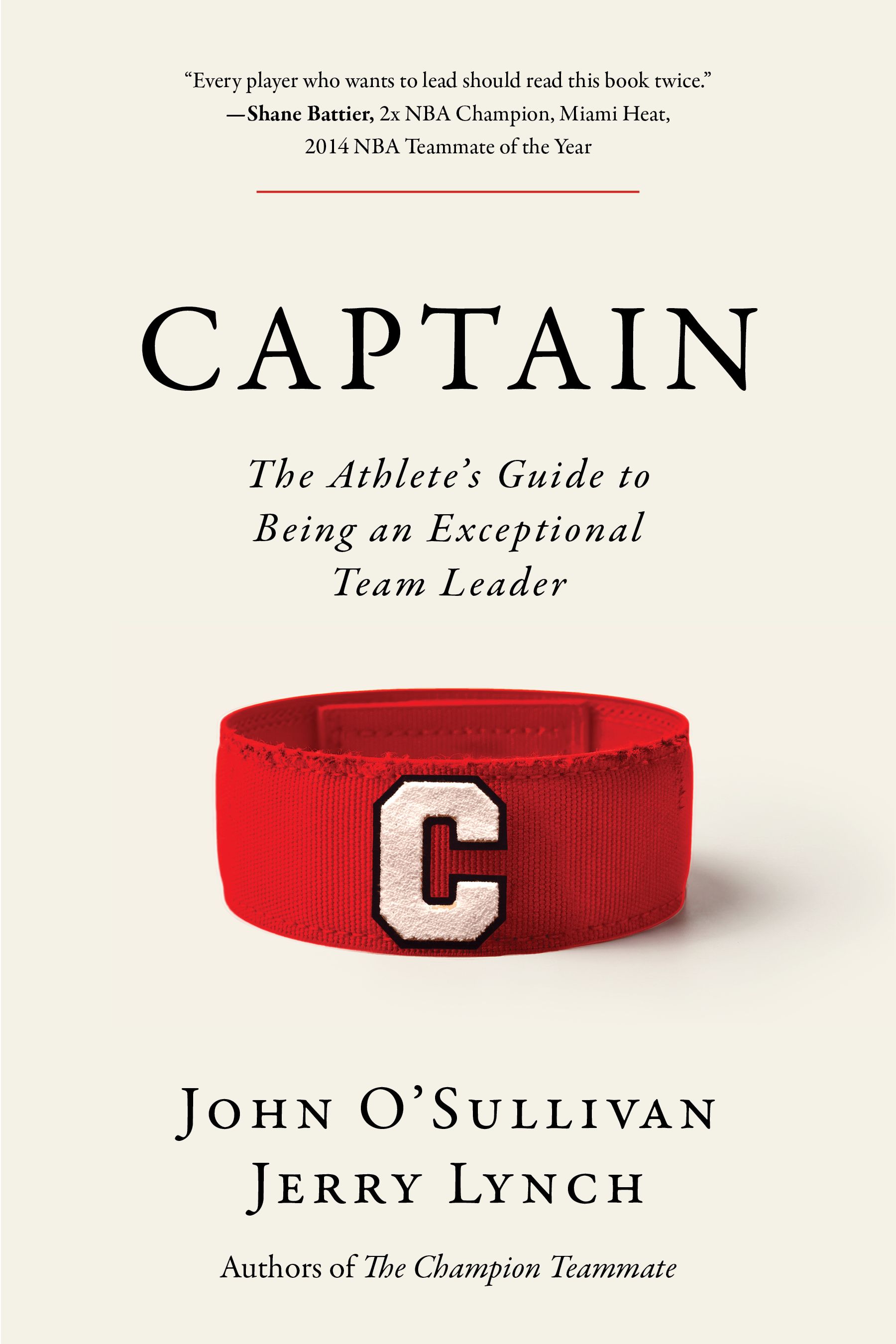
We are beyond excited that the release of our brand new book, Captain, is upon us. Jerry and I poured our hearts and souls into this book because what we keep hearing from coaches at the high school and collegiate level, and even the professional level, is, "Where have all the leaders gone?" We've shared our book with a few select people, and here is some of the advanced praise we have gotten:
“The intangibles I built a 13-year career on—the glue guy stuff that never made the box score—are exactly what Jerry and John teach in Captain. Setting standards. Reading the room. Doing the thankless work between the coach and the locker room. Most leadership books treat captaincy like a personality trait. This one treats it like a skill, which is the whole point. Every coach should hand a copy to their captain candidates. Every player who wants to lead should read this book twice.”
—Shane Battier, 2x NBA Champion, Miami Heat
“Great leaders on a team help guard the culture. Great leadership is the key to getting through tough stretches. In the absence of great leadership, a team is vulnerable to ‘ringleaders’ who fuel division. It takes time to develop great leaders and must be done intentionally. Jerry and John’s book will help you develop your current leaders and identify your future ones.”
—Tara VanDerveer, former Head Coach, Stanford University Women’s Basketball,
3x NCAA Champion, Olympic Gold Medalist,
All-time winningest NCAA basketball coach
“Captains can shape so much of what matters most on a team. They can help set the standards, fight for the culture, and keep a group together in tough times. Having been one, I know leadership isn’t automatic and must be developed. When we intentionally train captains, we don’t just improve individuals. We help good teams become great. This book will teach you how.”
—Chris Armas, MLS and NWSL Head Coach,
and former Captain for Chicago Fire
and U.S. Men’s National Team
Today I wanted to share a chapter from the book on leading everywhere if you want to lead anywhere. This chapter comes from part two of the book, "The Responsibilites of Great Leaders." It tells the story of U.S. women's soccer great Abby Wambach and how, during her final World Cup, she was relegated to the bench. She realized in that moment it would define her career and that if she couldn't lead from the bench, she could not lead from the field.
Chapter 14: Be a Leader Everywhere
If you’re not a leader on the bench, don’t call yourself a leader on the field. You’re either a leader everywhere or nowhere.
—Abby Wambach, World Cup and Olympic champion
By the dawn of the 2015 Women’s World Cup, Abby Wambach’s trophy case was filled to the brim. A former FIFA World Player of the Year with two Olympic golds and a record-breaking goal count, the U.S. women’s national team legend had conquered every peak except one. But at 35, she was not the player she once was, and she faced a crushing reality: She was being benched during her final quest for the World Cup.
When Coach Jill Ellis delivered the news, Wambach was livid. She spent 24 hours in a fog of devastation, anger, and tears. Then came a career-defining epiphany. She realized her legacy wouldn’t be forged by her best moments, but also by her hardest ones. “I had a choice to decide what kind of teammate I was,” Wambach later reflected in an interview with The Players’ Tribune. She chose to embrace the sideline, later calling it the greatest test of her life and a defining moment of integrity.
Wambach transformed from a scoring machine into the team’s spiritual anchor. From the bench, she didn’t just watch; she led—cheering, mentoring, and “doing the dirty work” in the closing minutes of games. When the final whistle blew on a 5–2 victory over Japan, she finally hoisted the trophy. Yet the wisdom she gained was life-changing. As she wrote in her memoir Wolfpack, “If you’re not a leader on the bench, don’t call yourself a leader on the field. You’re either a leader everywhere or nowhere.”
When circumstances shift and our roles diminish, the human instinct is to complain, mentally check out, or create drama. We suffer because we crave a reality that no longer exists. However, as Wambach proved, clinging to “how things should be” only results in lackluster performance and toxic culture. True leadership isn’t found in the starting lineup; it’s found in how you show up when the world isn’t looking at you.
If you are going to lead, as Abby Wambach says, you can’t just be a leader when things are going well for you. You can’t just be a leader when you are on the field. If you’re not willing to lead from the bench, if you’re not willing to lead from the locker room, and if you’re not willing to lead on the bus or in the classroom, you will never be respected and have the influence of the leader that you are capable of being.
Being a leader doesn’t mean that you are perfect. It does not mean that you will not make mistakes. You might even lose a game for your team, but that’s okay as long as you are willing to be accountable for your mistakes and help others be accountable for theirs. You must own it.
If you are someone who builds your teammates up after they make a mistake instead of tearing them down, you are a leader. We all know when we get something wrong and we all feel terrible about it. Why do we think that making someone feel worse will make them perform better? It doesn’t. Sure, we see some leaders on the court or field tearing into their teammates, but what is happening behind the scenes?
Wes Brown won multiple Premier League titles and the Champions League with Manchester United, playing alongside players such as Cristiano Ronaldo, Wayne Rooney, Ryan Giggs, Paul Scholes, and Roy Keane. Keane was the captain of those United teams and was well-known for being a very intense and vocal leader. Yet Brown told us on the Way of Champions Podcast that what people did not see was the quiet individual words that Keane would have in the locker room with the young players. After you played a good game, he would come over and tell you one-on-one how well you did. How well you fulfilled your role. He would lift you up far more than he would tear you down. So much so that Brown said you wanted to do well for Keane because you respected him so much.
Being a leader is all about influence and winning the relationship game. Your influence will never be stronger than when you are serving your teammates, than when you are making them better, than when you are doing more than you are even asking of them:
● Be the first to pick up the balls and cones after practice.
● Be the first to grab the water jug off the bus.
● Be the first one on the field and the last one to leave.
● Ask “What can I give?” instead of “What do I get?”
Never forget that your most influential leadership moments might come during your most difficult times, just like they did for Abby Wambach. Lead from everywhere, or you will lead nowhere.
Optimize Your Leadership
- How does the story of Abby Wambach resonate with you? Have you ever been asked to lead when your role on the team was not what you hoped it would be?
- What do you need to start doing that you are not currently doing to be a leader everywhere?
- What do you need to stop doing that you are currently doing in order to lead from everywhere?
- How can your leadership group help each other to be leaders everywhere?
- How can the coaches help support your leadership group in this area?